Monday, June 01, 2009

Painting Robby Robinson.


Yesterday was an extraordinary day for me. I had the honour of meeting Robby Robinson, the legendary American Bodybuilder whose portrait I am to paint. Those who know me from days of old, from the days of grueling workouts 6 nights a week at the Cosmos Gym in Sale, will know how very special this was for me. In those days from the late 70's through the 80's Robby Robinson was a godlike figure whose life sized image adorned the gym walls along with the other great bodybuilders of the era, such as Arnold Schwarzenegger, Franco Columbo and Frank Zane.


Robby is now 63 years old, and yet his physique remains a magnificent statement to the benefits of weight training, a disciplined lifestyle and a healthy diet. A lot of nonsense used to be said about bodybuilders, I heard a lot of it when I was training hard, that they would turn to fat when they got older etc. Take one look at Robby Robinson and there is your answer. 63 years of age with the body of an incredibly fit 20 year old.

If someone had whispered in my ear back then, that one day far in future I would be meeting Robby and painting his portrait, I would have fell off my seat, and yet here it is! Life is surreal and wonderful sometimes.

Robby was a true gentleman, generous and friendly, patiently holding poses for my camera. Thank you Robby and thank you Arden, our meeting was more special for me than you can imagine.

This ones for Bill, Paul, Rob Kelly, Gary Kenyon, Sami, Nige Fletcher, Gavin, the egg, and all the guys from those awesome never to be forgotten days at the Cosmos! I know you all fell of your chairs reading this!

Sunday, February 01, 2009

Developing an appreciation of great art.


Art is of great importance, both to individuals on a personal level and to society as a whole. Art is an uplifting and enduring statement of what human beings can do when they become inspired. It communicates it's message freely to anyone and at any time. I am awed and humbled by the great paintings of the past, they speak to us on so many levels not only about themselves, but also about the people who created them and the culture from which they came. They are proud monuments to civilization that challenge future generations to do better. I love these great paintings, done with such energy and on such a scale that they are truly breathtaking. As a painter I find them inspirational and challenging in equal measure.

I visited Manchester City Art gallery this week, as I do whenever I am in town and I heartily recommend it. I first visited the gallery as a child and fell under the spell of two paintings in particular, the first is the great Chariot Race by Alexander Wagner and the second is the awesome Victorian depiction of a Viking burial at sea. They speak to me today, just as they did when I first saw them, and keeping with family tradition, I decided to take my son along for an introduction to the world of truly inspiring art.


I think he got the message, on a subliminal level at least :)

For more information about Manchester city art gallery visit their website at:

http://www.manchestergalleries.org/

Saturday, November 29, 2008

Walking on thin ice.


Oil on board 24 x 54 inches.

Sunday, March 16, 2008

Sympathy for the devil.


Why IS the hyena so demonized and despised? Surely in this more enlightened age it's time this poor creature was given an image makeover.

I've met quite a few hyenas in my time and Personally I think they are wonderful creatures and not at all deserving of their reputation as cowardly and timid predators, on the contrary they can be bold, courageous and intelligent hunters. The Hyena is Africa's most common large predator and arguably it's most successful. Surely it deserves respect for that. It is supremely adapted to life in all areas of Africa from Savannas to grasslands, woodlands, forest edges, subdeserts and even mountains up to 13,000 feet.

Did you know? that Hyenas have the most powerful jaws on the African plains enabling them to eat everything they kill, The only parts of prey not fully digested are hair, horns and hooves; these are regurgitated in the form of pellets. As hyenas hunt mostly at night and devour all parts, little evidence remains of their meals.

Although hyenas eat a lot of dry bones, they need little water.

Their clans are very complex social affairs, which can be up to 100 members strong and they even organize themselves into using special 'toilet' areas. The females are dominant over the males and are heavier than them. The females genitalia are very masculinized which contributes to their being aggressive. This is due to the presence of higher level of testosterone in the female's body than that of the males.


They make the most varied vocalizations, including wailing calls, howling screams and the well-known "laughter" used to alert other clan members up to three miles away of a food source.

Hyenas are also wonderful mothers suckling their young for up to 18 months.

There is a lot more to the hyena than meets the eye! I definately think they deserve a little more respect than they get.

Above is part of an acrylic painting I did many years ago. I observed these particular hyenas hunting on the lake in the middle of Ngorongoro crater. I was fascinated to watch them playing dead, they were waiting for a flamingo to venture too close and then they would spring to life and catch it in an instant. I discovered this painting recently gathering dust in my attic. Such was the hyenas reputation that there was never any point in me displaying it at my shows. I dont know if people are ready for hyena paintings even now, but I'd like to think that people are beginning to realize what an amazing animal this really is.

One last little hyena story.... I once camped out on the Serengeti plains which was an amazing experience, but not without it's problems. What do you do in the middle of the night if you have a bad case of 'Africa tummy' and are desperate for the toilet, but all around the tent you can hear hyenas calling and whooping to a pride of angry lions making equally loud noises a short distance away! It was a very long and painful night I can tell you!

Labels:

Sunday, February 17, 2008

My amazing creation.


No, not the polar bears, not quite yet. The large polar bear painting is almost complete, but I'm afraid I didn't quite manage to finish it before my other creative project came to fruition, the birth of my son Bjorn! Bjorn is an old norse name meaning 'bear' which seemed appropriate for my little cub, a beautiful boy born on 6th february. Karin and I are over the moon and I'm allowing myself this brief hiatus where I'm catching sleep whenever and wherever I can, enjoying and bonding with my beautiful little boy. A chip off the old block wouldn't you say!


Wednesday, January 30, 2008

Robby Robinson - An inspiring Artist.

Yesterday I received the following message from bodybuilding legend Mr Robby Robinson:

"Your success makes me proud. You found the passion in art to make a name for yourself. The key is the fight inside of you. You are someone that I would want in my foxhole. I checked out your blog. Your work is extraordinary! You obviously found your passion. Kids need to hear more positive accomplishments not just in the art of bodybuilding. Much continued success.
Best wishes, peace, ROBBY"

I was so inspired by his comments that I feel compelled to write something about it. Robbys words are very profound indeed. 'The key is the fight inside of you' How true this is. Artists need to nurture their talent to keep it developing throughout their lives. This is not easily achieved and it's something professional Artists need to take on board.

Robby Robinson at 61 years of age still has the Olympian physique of an incredible athlete. He knows perhaps more than anyone, how to win those inner battles, how to stay focussed, motivated, determined and inspired over the course of a lifetime. But what has all this to do with art?

Robby Robinson is an artist of the highest caliber, who over decades of intense work, has created a living masterpiece of human sculpture - himself. Not only has he created it, but he has continuously worked on it and improved it over more than 40 years. The drive to create something beautiful exists within the hearts of artists and bodybuilders alike. It is no suprise to me when I discover with amazing frequency, artists who started out as bodybuilders. The two are more closely linked than is at first apparent, and much can be learned from someone like Robby Robinson.

He got me thinking about inspiration itself and how very important it is. What inspires me and keeps me going? well obviously trekking for tigers or setting out across the frozen wastes in search of polar bears is incredibly inspiring.....


But Robby has reminded me of something else, something quite different that is easily overlooked:

We are collectively inspired by the deeds of others, and when we learn of great achievements we are uplifted and inspired to greatness ourselves. How many masterpieces have been inspired by Rembrant or Beethoven? How many Champions were inspired by Ali? How much courage has been instilled in men by Churchill?

It's good to have heroes, as we all benefit from their reflected greatness. Great deeds, and great achievements are infectious and this makes them even more precious than if they were merely to exist in isolation. Kids need heroes, they need to hear of positive achiements, they are the lifeblood of the human story.

I have always had heroes to inspire me and drive me to greater and greater efforts. I was born with a burning desire to achieve greatness at 'something' I just didnt know what that 'something' would be. I wanted to leave my mark on this world and looked around me for heroes.

I tried many things from writing and art, to martial arts Boxing and Bodybuilding. Art seemed too obvious at first, I was always the best in the class, and to a young man it didnt quite equal the appeal of being a sporting superstar, there didnt seem to be the challenge I craved. ( How wrong I was in that! )


( emulating the late great Bruce Lee in 1975, and in 2001, a humorous stand off with supermiddleweight champion of the world, the dark destroyer Mr Nigel Benn. )

Robby Robinson caught my eye as an incredible character and I trained fanatically with a grim determination to build a physique that would equal his, eagerly reading everything I could on his training routines and dietry discipline. It was a very happy time of my life and one that has done me perhaps more good than any other. Genetics were not in my favour however, and when it became clear that others were considerably more genetically predisposed to the sport than I was, the passion deserted me and weight training simply became a hobby and a means of fitness rather than a lifes passion. The end came when one day I showed my training partner a portrait I had done of Arnold Schwarzenegger. His jaw dropped, he turned to me and said "If I could draw like that I wouldn't waste my time in the gym" At that very moment I realized that the obvious had been staring me in the face all along - Art was where my true talents lay.

My bodybuilding period was a very valuable lesson in life and a very positive experience however. It gave me great personal discipline and set me on a course for health and youthfulness which I am now enjoying as I head towards 50 years of age. This is a particularly good thing for artists, who spend far too much time sitting down. They can benefit greatly from a bit of physical discipline. I am so glad I absorbed the positive healthy way of life that Robby Robinson taught me all those years ago.

He never knew it, but simply by doing what he does so well, he had impacted upon my life in a very positive way. I cant tell you how proud I was to receive his message and even moreso, to learn that he is still going strong at 61, inspiring a whole new generation of people to improve themselves and follow a positive path in life.

He still inspires me today, and instills in me the will to be the best that I possibly can be, and to dare to think, that my efforts will in turn inspire others.

Thank you Robby, and if ever we were together in a foxhole, I would not let you down. :)

Wednesday, January 09, 2008

The spirit tiger...


What do you see when you think of a siberian tiger? Have you ever imagined one? have you ever seen him in your minds eye as he surveys his frozen land? I have. I have a recurrent dream of an absolute behemoth, an 800 pound male prowling the frozen forests of the Russian Far East.

I am standing in the silence that only a snowfall can deliver, all sound absorbed by the mist that hangs heavily around me. Slowly, inexorably a shape begins to form out of the frozen air with the dreamlike quality of a photograph developing. Only now do I hear the dulled sound of snow being squeezed under soft and heavy paws. It is he, the behemoth, the legendary Amur tiger, largest of all the big cats striding effortlessly towards me with a fluidity of movement that belies his immense weight and power. His wild eyes pierce the mists and his jaw hangs loose revealing his tongue and glistening teeth. Despite the intense cold, he is panting to keep himself from overheating. He stops before me turning his head as if to see where I am hiding and exhales powerfully with a sound so deep I feel it in my chest. His hot breath freezing instantly in the air. I hold my own breath for fear he will hear it but my heart beats so loudly I am sure It will betray my position. For what seems an eternity he stands frozen, the image of untamed wildness, and then miraculously he turns his mighty head again sniffing the snow as it tickles his nose and dissapears silently into the fog. I am left traumatized and yet wondering as silence returns "Was all this just my imagination? or did that really happen?"

I have taken many, many walks in tiger forests carrying nothing more than a bamboo stick and believe me, the fear of meeting a tiger when you are on foot is a very deep primordial feeling that probably lodged itself into my subconscious. You dont think so much of it at the time, but later in those quiet moments, you imagine the nightmare 'what if?' scenarios.

The irony of course, is that the tiger has far more to fear from man than we have ever had to fear from him.

I decided it would be good to paint my dream. It was quite a challenge. I attempted it once before with the painting 'Greeting the first snows of winter' and this time I wanted to make it more up close and personal.

I hope you like it.

Saturday, November 17, 2007

Step by step pastel demonstration.


A tiger at the waters edge, Royal Chitwan, Nepal.

People often ask me "How did you do this?"

This is how....

I am using Royal Sovereign pastel paper as always, you will notice from the images below, that this painting started with very little drawing. This is often the case with my pastelworks. I like to make proportional marks where things might be, such as eyes, an outline or the stripes on the tiger, but these are no more than guide marks as any underdrawing would be immediately lost with the amount of pastel I lay ontop of it.

Picture One:


The second picture shows that I am working firstly on the head, concentrating upon the contrast it will have against it's background. This is very important to the success of the whole picture, and so I take time to do a bit of detail and get a nice deep contrasting colour for the background firmly in place. Another reason for doing this is that I found it inspiring to have the face semi done at this stage, it made it easier for me to visualize the completed picture.


The third picture shows that I am working the background colours further down, testing my ideas out with experimental colours for the grass and also trying out some of the light shafts that will later enhance the picture. These are all just ideas at this stage and if you look at the finished painting, you will see I changed the direction of the light shafts to improve the composition.


The fourth picture shows me spreading out undercoat colours across the body of the tiger and lightly drawing in the stripes. I'm also adding a few details to the legs.


You may notice that everything is done lightly at this stage, nothing too drastic and severe. I often describe that I feel like I'm dipping my toe into the waters, testing things. I never rush in. If I make mistakes at this stage it's easy to correct them and all options are always open for any new idea that might arise by looking at what I've done so far. I'm always looking, always stopping and thinking, this is the time when paintings are won or lost and what I'm after is a blueprint that I know I can safely take to the next stage.

People often ask me about composition. Was it all planned out? I hope to demonstrate with this post that it wasn't. This painting began in Nepal one morning when I was on the back of an elephant looking for tigers, the jungle at Chitwan is shrouded in mist until the sun rises and burns it away. As my elephant went to the water to drink I soaked up the scene before me with it's dramatic light and mist clearing away. I didn't see the tiger that day, but in my minds eye I had clearly seen him and the painting was born. That is as far as my composition went, a misty background and an imagined tiger.

I returned to England with some tiger sketches and photographs but nothing as dramatic as I had imagined that day.

Months later I sketched out the tiger I wanted. You will see that he is oddly composed, he is entering the space of the picture, stepping into the frame incomplete, just as my imagination had placed him in the actual scene many months before. I like this type of composition, but it poses challenges if you are to get it right. I had my misty background to wrap around him and a vague idea of backlighting, but I knew that something more would be required if this painting was to succeed...

You will see that at this stage I am spreading out, 'feeling' for those compositional elements. At the top I have settled on the direction of the light shafts and at the bottom I have started the water. I always knew I would Have light shafts and water, but their exact positions I left until doing the painting. I like working with this kind of flexibility, it suits the cautious way in which I work, little decisions one at a time. It often feels like the painting paints itself because each decision leads effortlessly to the next.

You can see here in picture 5 that I am bringing in a few details of the grass, feeling for my colour/tonal range.


Picture 6 shows that having got a feel for the colours of the grasses I am now confident enough to lay down some of the foreground grasses, always mindful of the lighting, it had to be dramatic to suit the light on the tiger. I'm watching the composition carefully here, extending the tigers influence downwards in the reflected paws which I liked, but it began to feel as though the bottom right of the painting was uncomfortably empty. You have to be very careful when your animal fills so much of your canvas, very aware that anything else you add must enhance and not distract from the main subject.


Picture 7 shows my answer to that problem. I decided upon a log to balance things up a little, and I also added the subtle touch of extending a stork of grass upwards on the right, both to balance a picture that was in danger of becoming unbalanced.


Picture 8 shows more refinement of the log, and a completion of the top section, light pencil strokes giving hints of a jungle in the far distance.


Picture 9 shows a bit more detail of how I am now finishing the fur across the tigers body, light strokes of lighter fur lifting out of darker richer undertones which suggest the underlying anatomy of the animal. All the time I am gently softening with my fingers.


Picture 10 is a close up of the finished body, much lighter strokes on the top of the back and finally the darker stripes get carefully added. Whiskers and the brightest elements of the fur are always done last. Soft pastels being used for the high whites as they lay down more powerful pigments than the pencils.


And there you have it!

I sincerely hope that this demonstration shows that photographic realism is not whats on my mind when I compose a picture. I am much more concerned with the challenges of colour and composition. My attention to detail might make me photo-realistic, but I'd like to think that people can see a lot more in my paintings than just the realism.

Eric :)

www.ericwilsonwildlifeart.com

Thursday, April 26, 2007

Hunters kill one of last surviving Amur leopards


Further to my last post, I now sadly add this one as a classic example of how close we are coming to losing the most beautiful and awe inspiring creatures on the planet.

Hunters in Russia's Far East have shot and killed one of the last seven surviving female Amur leopards living in the wild, WWF said on Monday, driving the species even closer to extinction.

Last week environmentalists said there were only between 25 and 34 Amur leopards -- described as one of the most graceful cats in the world -- still living in the wild.

At least 100 are needed to guarantee the species' survival which depends upon female leopards breeding.

"Leopard murder can only be provoked by cowardice or stupidity, in this case most likely by both," Pavel Fomenko, WWF's biodiversity coordinator in Russia's Far East said in a statement.

A hunter shot the leopard through the tail bone. It tumbled over and was then beaten over the head with a heavy object, WWF said. Amur leopards have not been known to attack humans.

Environmentalists have urged the Russian government to introduce tighter controls on its national parks in the Far East to crack down on leopard hunting.

They also want more done to protect the animal's natural environment and food supply, which they say is being destroyed by human development.

A local wildlife watchdog received an anonymous tip-off that a leopard had been killed. State wildlife officers found the dead animal after a day of searching.

The leopard died three days after my last post.

I urge everyone to read my last post and take this message to heart. The time for leaving this issue to the goodwill of wildlife organisations has passed, it is time to recognise that the battle to save critically endangered species from extinction has been lost and the ONLY hope now, lies with our political leaders.

The current political thinking on this matter, is that the subject does not rank as important enough for them to do anything about it. Organisations such as WWF can be left to deal with the matter and if we lose the great animals of the world so be it, and this is exactly what is coming to pass.

Future generations will write volumes in condemnation of our current leaders for their wilful neglect of treasures so important, they have taken millions of years to evolve and can never be replaced.

It is imperative that we act now to open the eyes of our politicians before it is too late. They have to wake up and change their attitude now and give this issue the importance it deserves.

Yesterday it was announced that there are only 100 South China tigers left. How many people read that? not many I'm sure, as it would only qualify for an 'and finally' mention on the news if at all, the latest goings on in Hollywood or what minister should resign today being deemed much more newsworthy. What a self absorbed species we are.

Thursday, April 12, 2007

Are we saving the tiger?


No, We are not saving the tiger. The tigers future existence on this planet will be decided between a bunch of criminal animal traffickers and the whims of a handful of bureaucrats in the Indian government.

We have nothing to do with it. Despite our valiant efforts, our fundraising activities and our awareness campaigns over the last 35 years the tiger is now more endangered than ever before and it is now beginning to look like it's fate has been sealed.

It's time to tell it like it is, and to expose the myth that giving donations to wildlife charities is enough to save the last wild tigers from extinction. The amounts raised by the private sector are quite simply, too little too late and in any event, they are like providing funds for homewatch schemes with a hope they will prevent organized crime or sending donations to Africa believing it will put an immediate end to poverty and starvation and unlike the humanitarian disasters in Africa, the crucial difference with tigers is that once the they are gone, they are gone forever.

Is this acceptable? Is it right that we have absolutely no say in whether our children grow up in a world where tigers still roam pristine forests or whether they learn about them as they learn about Dinosaurs, as magnificent relics of a bygone age. I for one, do not find the current situation at all acceptable.

Who owns tigers anyway? Surely if they are wild, nobody 'owns' them, certainly not exclusively the group of humans who accidentally find themselves living next to them. If they belong to anything it is to the entire world. They are part of the magnificent biodiversity of this planet, they are perhaps the most awe inspiring and beautiful creatures that have ever lived and like so many things in life, we will only realize how much we loved and needed them when they are gone.
We will all feel their loss and we therefore should have a say in what happens to them. We have a share in them and that share currently has no rights.

We have no rights and yet we have responsibility. If we let them go extinct countless generations will suffer and they will not look kindly upon our generation who stood by and allowed this catastrophe to occur.

The time has come for a reality check regarding the many critically endangered species facing extinction within the next few decades. Politicians have for too long sat back and relied upon the good will of the general public to save them. This policy is clearly not working and a radical rethink is urgently required if these magnificent animals are to survive. The time for playing fast and loose with the worlds richest treasures is over.

I do not wish to criticize or belittle the efforts of fundraisers, conservationists, or wildlife organisations. They have done a magnificent job and clearly, many species would have long since died out if it were not for their efforts, but the status quo of having these animals teetering forever on the brink of extinction cannot continue. It only takes a regional conflict or a surge in the market for animal products and it is all over.

Tigers deserve more than this and we deserve better than this in an enlightened age where the longterm survival of these animals could easily be acheived, if only the political will of governments, not just private individuals was brought to bear.

Politicians are extraordinarily short sighted individuals, and the current generation seems blissfully unaware of the scathing condemnation that will be heaped upon them by future generations should they be stupid enough to allow the extinction of something so precious as the tiger to occur. This is a serious issue, and yet I sense people are becoming tired of hearing about endangered species, they are becoming complacent and there will widespread shock when the news finally hits home that all the tigers in the world are gone, never to return. Only then I fear, will people wake up and they will be extremely angry.

So what should be done?

Nations have recently shown themselves capable of agreeing international action over such things as climate change. Are endangered species not every bit as important as that? The time has come for Governments to say that species such as the mountain gorilla or the tiger are too important to be the sole responsibility of the country in which the animals live. Another war in Rwanda for instance, could be enough to wipe out the last remining mountain gorillas. This is no longer tolerable. Similarly, an inept Indian government that takes it's eye off the ball is all that it takes for tiger poaching to become widespread as has been demonstrated recently. This can no longer go on, just as no country would be allowed to pollute indescriminately, no country should be allowed sit back whilst the worlds natural heritage is lost forever.

As with climate change, international agreement should be reached at the United Nations. An international organization should be set up providing funds, manpower and expertize to help countries protect the national parks containing critically endangered species. Targets should be agreed for the increase in populations of such species and independant inspection by experts in the field should be regularly carried out. Rewards for good custody of the parks and Penalties for nations failing to properly manage them should also apply. The time for all this being done on goodwill alone has passed. It has been a failure and cannot continue.

In cases of emergency, U.N. personell should be deployed to conflict zones to ensure the integrity of park boundaries.

This may all sound far fetched but it is not beyond our politicians to acheive it. The only thing lacking is the will to do it and the vision to see how incredibly important this issue really is.

If the day dawns when we no longer have tigers, mountain gorillas or orangutans, people will ask why this wasn't done and it will seem so obvious that it should have been.

Thursday, November 16, 2006

Portraiture in pastel.


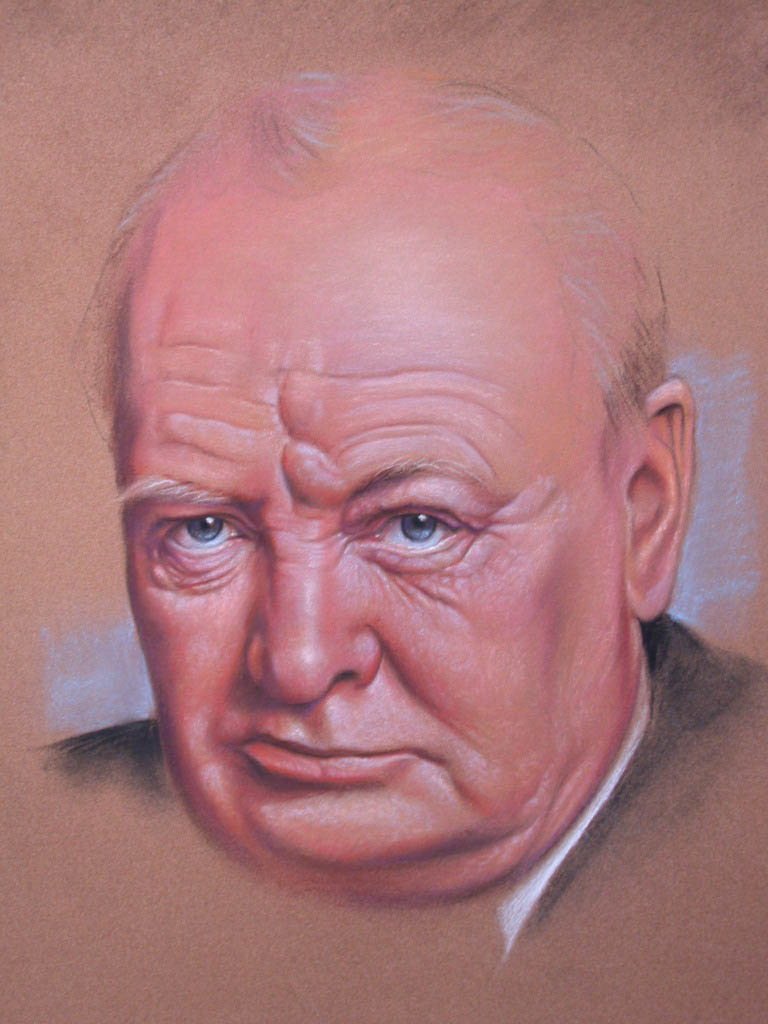
I love to do portraiture, and pastel is a joy to work with for skin tones. My Winston Churchill portrait was a challenge, because the subject is (sadly) no longer with us and all I had to work from was a small black and white image in a book. I wanted to breathe life into Winston and bring him back to us in glorious colour.

I include three pictures of the portrait at various stages. You will see that I am working in layers, lots of smoothing with fingers and then adding more pastel ontop until the skin really began to look as if it had blood running through it. The final layers of pastel were the reflected highlights in white or even a light magenta/blue. I used the same tone in the background to bring harmony to the picture. I paricularly enjoyed the highlights on the bottom lip, the nose and of course, the eyes which bring life to a portrait.

Winston Churchill is a very inspiring figure from history and I keep a print of this portrait in my studio to keep me going when times get tough. I can't have the original unfortunately, as it hangs in the study of a good friend and collector of my work.

Tuesday, September 19, 2006

Fancy a painting holiday in the Scottish highlands?


I am often asked by Art groups to give slide shows from my expeditions and to talk about my painting career. I enjoy doing this and have started giving personal tuition to Artists aswell. I've had very positive feedback and recently began to wonder if I should hold an Art class for a weekend of painting tuition in a beautiful location somewhere.

My imagination got the better of me as I imagined taking a group of painters to my favourite places in Africa or Nepal ....or maybe Yosemite national park? I thought about it all for a while and decided I'd better pick somewhere nearer to home to begin with and of course it had to be my beloved Scotland.

I've been sailing and trekking my way around the highlands my whole life so I'm pretty much an expert on where to go, and so there I was last week making out a wishlist of hotels and venues to approach when the most amazing coincidence occured! I received an email from the Dundonnell Hotel at Little Loch Broom asking if I would consider holding a class for a painting
holiday in the highlands!

It's a beautiful Hotel in a magnificent location - perfect! What we have in mind is an intimate group of people (12 maximum ) for a weekend at the hotel which would include dinner bed and breakfast where I would hold painting classes, give talks and personal one to one tuition for the weekend including (Weather permitting) day trips for painting, sketching and photography in the beautiful highlands around Torridon and the lovely Scottish coastline with its bird and sealife.

It is envisaged that the whole weekend ( Frday & saturday night, departing sunday afternoon ) would cost just £299 per person.

The Dundonnell Hotel is run by Patricia Stevens and Robert Leggat. Wester Ross and the Northern Highlands are connected by the A82 and the main A9 trunk road to Perth, Stirling, Glasgow , Edinburgh and the motorway networks of the south. Inter city rail services and regular scheduled jet flights to Inverness have also brought the area closer to the rest of the country. Car hire is available at the airport and in Inverness.

Transfers from Inverness by car, luxury coach or self drive can be arranged to suit your needs.

Helicopter Landing facilities available at hotel - charters arranged to suit client requirements.

Distance by Air to Inverness
Ex London 1½ hours
Glasgow 40 minutes

By Road to Dundonnell
Inverness 1¼ hours
Glasgow/Edinburgh 4¼ hours
Aberdeen 3½ hours


From Inverness, head west towards Ullapool and follow the A835. At Braemore junction take the A832 for Gairloch until you reach Dundonnell.


For more information on the hotel please take a look at their website @ www.dundonnellhotel.com

If you think you might be interested in a painting weekend please get in touch with me @ ericwilson1@btinternet.com or contact the hotel directly. At the moment we are hoping to make it the first weekend in november but it all depends upon the level of interest.

I hope to see you with your paintbrushes or pastel sticks soon!

Monday, September 04, 2006

Steve Irwin - An inspirational man.


I haven't posted for a while, as I've been busy working on a large landscape painting, but todays awful news has made it difficult for me to concentrate and so I thought I'd express my feelings on here instead.

Steve Irwin was a hugely inspirational man, I loved his wildlife documentries and was always impressed and inspired by the genuine love he exuded for the animals he worked with. I would watch his programmes with my children and marvel at the way he captured their imaginations and opened their eyes to the beauty and wonder of the natural world. He was infectious in the most positive way and in a world of negative influences he is one person we could not afford to lose. His passion for nature was equalled only by his passion for life itself that positively radiated from our screens. To watch him was invigorating.

Steve Irwin brought so much good to this world, inspired so many people, and did so much desperately needed work for conservation. He was a treasure not only for Australia but for the whole world and his death is an absolute tragedy. My heartfelt sympathies go out to his wife and family. The only comfort is that Steve died doing what he loved and was blissfully happy right up until the moment of his death. How many of us will be able to say the same when our moment comes? How many of us have lived so well? This man really lived, he had passion, energy and the courage to take life by the horns and live it exactly as he wanted to.

Inspirational even in death, Steve Irwin, what a beautiful life. It is we who are left behind that are the losers. You will be sadly missed but never forgotten.

Crocs rule!

Sunday, July 23, 2006

New Book.


Greetings everyone!

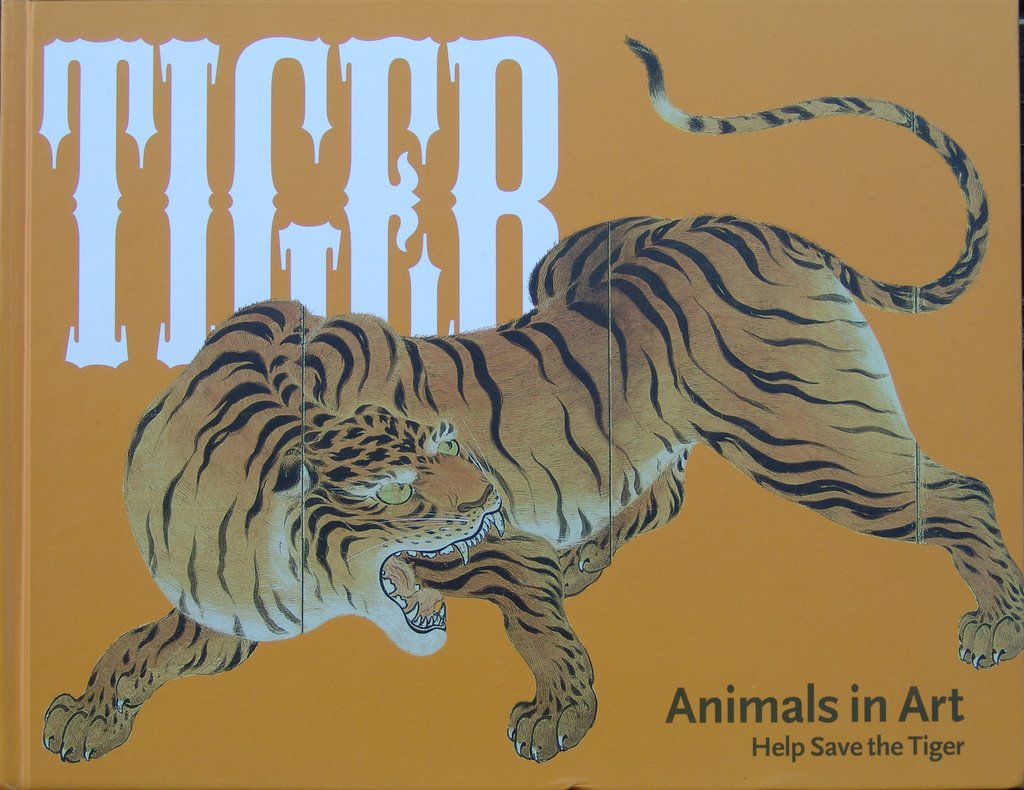
I'm happy to announce that a new book has just been released containing my artwork. It's a really beautiful book by Joanna Skipwith of Silver Jungle Ltd. covering tigers painted by Artists from myself through to Rubens and Dali. I am proud to share a book with such people and particularly proud that all profits from the book go to 21st Century Tiger who spend 100% of all donations on helping to keep tigers in the wild.

The book is available at the National and Tate Gallery and is available through Amazon and 21st Century Tiger.

If you are visiting my blog for the first time, please take a look at the archives, I've been adding pictures and articles for some time now and I'm sure you will find something of interest.

Sunday, July 16, 2006

Painting at Nature in Art.


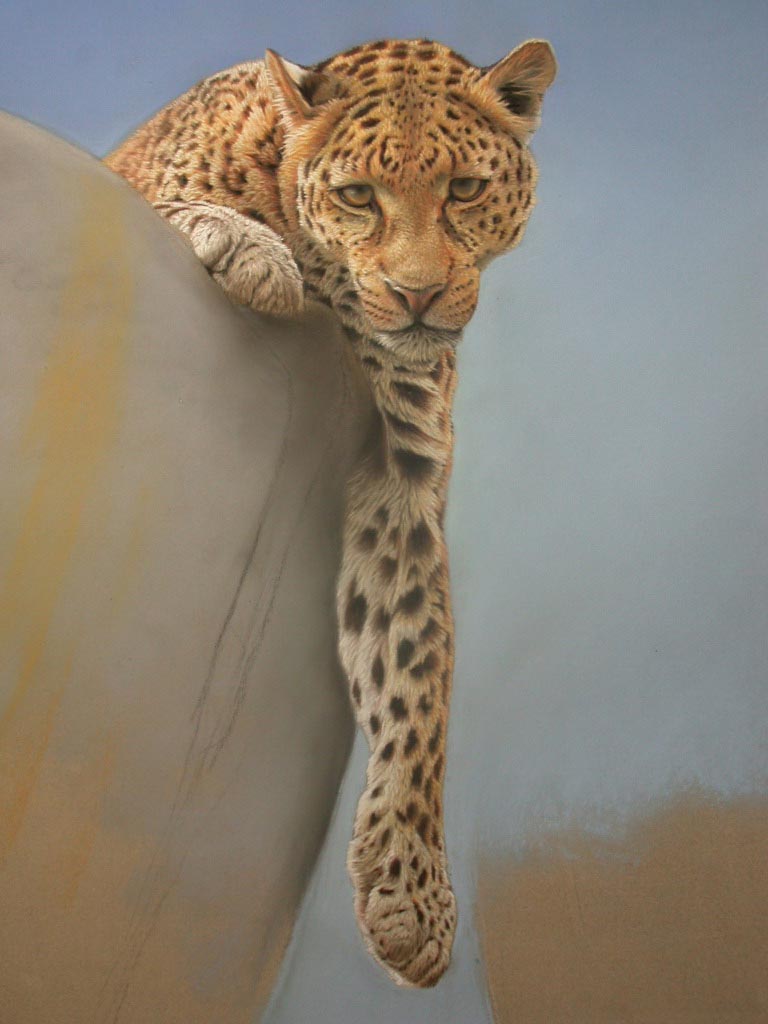
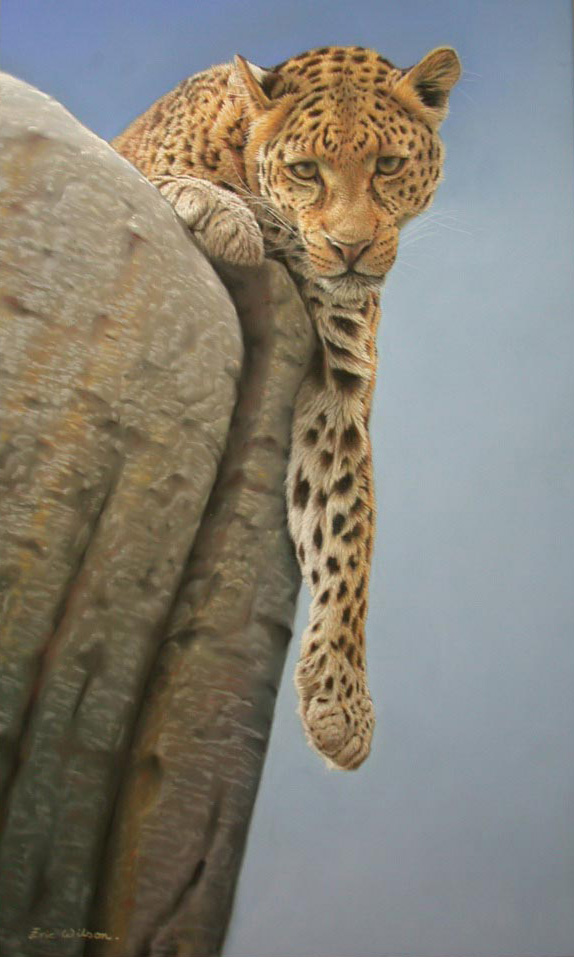
Those that came to see me as Artist in residence at the Nature in Art Museum a couple of years ago might remember me sketching this leopard in pastel. It's very different for an Artist to work infront of an audience compared to working in the solitude of your own studio, and for this reason I had decided to just start sketching freehand without any idea of what the result would be.

I usually have access to lots of photographs that I've taken when composing a picture but for this one, all I initially wanted to do was a leopard in a characteristic pose with it's paw hanging down so I started freehand without any reference whatsoever. I figured that if things didn't work out by the end of my week then at least I'd have entertained people as I struggled with the pose. To my suprise as much as anyone elses though, the leopard began to look pretty realistic and for a moment it was quite a scary feeling as I hadn't considered any background elements at all.

You might notice from the pictures, that I considered adding the leopards back foot but decided against it as I felt it upset the composition and drew unecessary questions about the leopards anatomy behind the rock and I felt I was pushing the limits of belief as it was. I'd initially thought of a branch for the leopard to be on, but each one I tried seemed to alter the composition of the painting in a negative way, and so I settled on a rock to cover a multitude of sins and keep the simplicity of the picture which I instinctively felt was it's strengh. I could so easily have become over ambitious and ruined things at this stage. I also considered a second rock to the bottom right, but again, decided this was unecessary and brought the sky down to the bottom.

It was these final decisions that made all the difference between this picture working or failing.
It could so easily have ended up in the dustbin but by keeping the picture simple and true to the initial sketch it worked and has now become my third best selling image!

~In Art, Sometimes less is more.~

It's difficult to teach such intuitive things. Teaching technique is basic and easy, but understanding the philosophy of why one painting works and another fails is something all serious Artists should meditate upon.

As a matter of Interest I will be painting once again at Nature In Art Next year.

Thursday, July 06, 2006

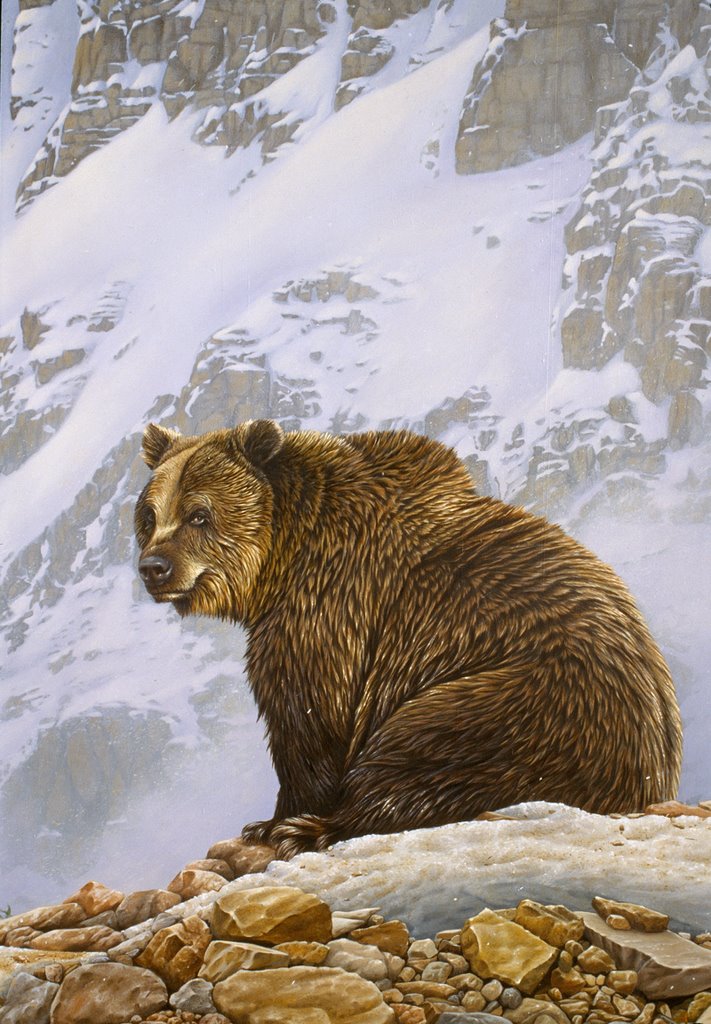
The old man of the mountain


A few years ago I decided to visit the Canadian Rockies. It's the kind of landscape I always dreamed of as a child with it's huge mountains, endless forests, pristine rivers and lakes. I loved exploring Banff and Jasper national parks and tried to cover as many mountain trails as possible.

One morning I set off from Jasper on what was supposed to be a short trek looping around some spectacular lakes and returning me to the main Jasper highway 13 kilometers later. It was a beautiful walk, a real feast for the senses and I felt so extremely happy that I hardly noticed the hours slipping by until I suddenly remembered I was supposed to have looped around a lake by this time. I'd noticed several paths leading off the main track that I was on and began to wonder if I'd lost my way somehow. 'Maybe the lake is just a little further on' I said to myself and continued along the trail.

My spirits picked up a little when I saw a signpost nailed to a tree ahead of me. When I reached it it wasn't exactly what I wanted to read! It said 'Warning, Grizzly bear seen on this trail yesterday at 4pm. proceed with caution' by this time it was too late for me to turn back as I wouldn't make it back before nightfall. I decided to continue and about half a mile further on I noticed a tree where the grizzly had scraped its claws through the bark leaving deep cut marks, not the most reassuring sight as the sun began to set.

Things seemed to go from bad to worse that day, as the landscape began to change from pine forest to head high dense bushes, the very worst environment for a bear encounter as I would be more likely to suprise the bear and trigger an incident. The thing I most feared was a mother with cubs in such terrain.

As darkness began to fall upon the forest I was reminded of when I was 17 years of age and attended a boxing gym about 5 miles from my home at the end of a long dark country lane. I used to finish my boxing late at night and the only way for me to get home was to run the 5 miles along the pitch black road. Having been born with a vivid imagination every dark bush ahead of me became a mad axe murderer and every sound behind me a psychopath chasing me dagger in hand! Now here I was in another long dark lane where every brown bush began to look exactly like a hungry grizzly.

In my boxing days I overcame my fear of the long dark lane by impersonating Muhammed Ali! Running along the lane shouting quotes such as "People call Joe Frazier the heavyweight Champion of the world.. clumsy, ugly, flat footed Joe Frazier! he's too ugly to be the worlds champ, the worlds champ should be pretty like me!" I must of looked a ridiculous sight, but in my 'Ali trance' the 5 miles flew by and I was soon safely home. ( All the mad axemen must have ran when they heard Muhammed Ali coming their way and thankfully I never bumped into Joe Frazier coming the opposite direction! )

I have to confess Muhammed Ali visited the Rocky mountain trail that day, once again coming to my aid and warning any bears ahead of me that a human being was approaching. I didn't run of course, but made the whole forest aware of my presence as I walked.

Hours passed and I eventually came across a path with a sign that read 'Jasper 7km' and in the direction I had come from it read 'Jasper 27km' At last I had rejoined a path that would return me to Jasper!

I didn't encounter the grizzly that day, but in my minds eye I saw him on a ridge ahead of me, turning to look at the creature that had dared to enter his kingdom.

The old man of the mountain was the result of my experiences that day.

Friday, June 30, 2006

Seeing double.


Good evening all,

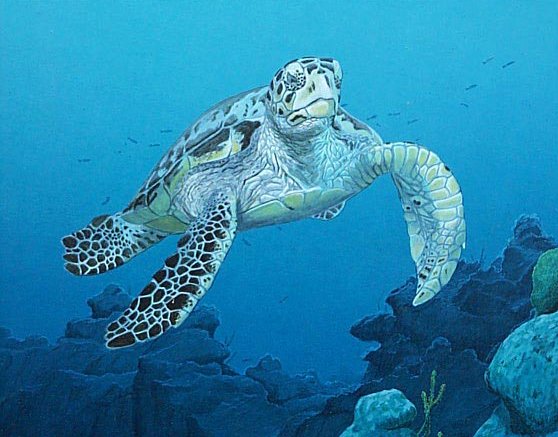
A few years ago, I did a series of underwater paintings in acrylics. I sold most of them before I managed to get them photographed which is a shame, but I've found in my archives these two paintings of Hawksbill turtles which I thought would make a nice colourful post on my blog.

There's a story behind these two actually, because originally they were part of the same painting. It was an oval picture of a reef with two hawksbills and I thought it was quite nice. Perhaps due to it's unusual shape though, I never sold it and it ended up stashed away in my attic until the day I decided to exhibit at the Florida Wildlife and Western Art Exposition.

I thought the subject was ideal for Florida, and when I heard they they were holding a miniature paintings section I made the bold decision to cut up the painting into two seperate paintings each containing a turtle.

I'm happy to say it did the trick! Both paintings sold at the exhibition. I never got to hear if the same person bought them both or if they ended up in two seperate homes. If anyone knows who has them please let me know!

Saturday, June 24, 2006

Final stages of the gorilla.


Three shots showing the final stages of the gorilla. I've included one of my pastel studio to show the layout of how I worked when doing this painting. You will notice that I took the gorilla to a level where I knew he was going to be a success, I then switched to the hard work of getting all the foliage correct, (including the butterflys that I photographed in Zaire precisely for such a painting), and then finished off the gorilla to complete the work.

This painting is now available as special limited edition print, if you're interested please click HERE to contact me.

Friday, June 23, 2006

Step by step gorilla.


I haven't got a lot of time to write at the moment, as I have three oil paintings to finish by 7th july which for me is a very tight deadline.

I thought I'd add the first of the gorilla series though, to show how I tackle a complex painting in pastels. I preferred to go 'bit by bit' with this one doing a little area each day. That way I could feel a reward after each days work. I sometimes find it hard doing a complex painting where I develop the whole thing gradually, because it takes so long before it starts to look good and there's a danger of losing one's attention.

I sometimes vary my approach to each new painting to help maintain my concentration levels.

Monday, June 19, 2006

A Gorilla in pastels.


A few years ago I was fortunate enough to spend time with gorillas in the wild. I've been face to face with many of the worlds most magnificent animals, from tigers to polar bears but there is something completely unforgettable about an encounter with a gorilla in it's natural habitat.

It took me about four hours trekking through the jungles of Zaire before I caught my first glimpse of these noble creatures. I was just thinking to myself how the jungle had come to resemble an overgrown English garden, and I almost felt I was back there when suddenly my eyes fell upon a huge silverback sitting peacefully amoungst the foliage only a yard or two ahead of me. All illusions of England vanished that instant and I silently and self consciously sat down before him.

That is how it feels when you disturb a gorilla in his home. It's different with lions, or bears, you look at them the way you would look at a cat or a dog, but with a gorilla it's almost like you are staring at your neighbour. You know he is regarding you with almost human curiosity, there is real sentience in his eyes and it's a humbling experience.

I spent several days with the gorillas and had some amazing experiences including being knocked flat on my back, being hit on the head with half eaten fruit that the youngsters throw at you from the treetops and watching in awe as a silverback snapped a two inch thick piece of fresh bamboo with a simple flick of his wrist. I tried to snap a similar piece by jumping up and down on it and couldn't!

I've painted only three gorilla pictures so far, and as they all sold quickly I think it's high time I painted some more...

I've included a picture of my Gorilla in pastels and will be adding pictures of how I did this painting in the next few days.

Friday, June 16, 2006

Why did you become a Wildlife Artist?


In my last post I showed a couple of paintings I had done as a child, and this has raised a question that I'm always asked at my shows:

"Why did you choose to become a Wildlife Artist?"

I think the answer is that I didn't choose it at all! It's something that I have always done. I've included two more childhood paintings ( I have many ) to show that from the very beginning, with my first set of watercolour paints I was painting wildlife.

I have always been inspired by Nature. The grace and beauty of wild animals is something that takes my breath away and for me it was the most natural thing in the world to choose animals as my subjects. Throughout my life I have painted them and will no doubt do so until the day I die.

It's not something I ever made a conscious choice about, it was the coming together of my two great passions, the natural world and my love of art. I think a true wildlife artist should be someone who has a real passion for nature and not just a gifted artist who has decided to paint a tiger or two.

I never really chose to do Art even, it was more like Art choosing me. It seemed like the most natural thing in the world for me to do and deep down I always knew that Art would become my life.

Whats significant about all these early paintings isn't whether they show any real talent or not, but the fact that I kept them for all these years. I kept them because I had the belief even then, that my work would someday be valued.

This is what makes an Artist. The love of painting, the love of your subject, and the self belief that binds it all together.

Saturday, June 10, 2006

For all the talented children out there...


I greatly appreciate all the feedback I get from my website and from this blog. One thing that in particular makes me happy is the email I receive from children who have been inspired by my paintings and want to become Artists themselves.

I would like to say a big thank you to you all. It's good to have goals in life and for me to be someone others aspire to become is a real honour.

Thank you for the wonderful pictures you send me that always seem come with the words:

"It's not as good as yours but..."

As I always point out, you should not compare your work to mine as I wasn't always able to do what I do now, and who knows? by the time you are as old as me you might be better than I am!

To help make this point to you all, and to help you make a fairer comparison between your work and mine, I have added two paintings I did as a child. One a pencil sketch that I did when I was 11 years old that I sketched from life whilst on holiday in Scotland, and the other a watercolour painting that I did whilst at school ( For the school wall no less!) when I was 10. I hope this will show that people like myself didn't always paint the way we do now, but with dedication and practice, we have honed and improved our skills over many years and ....

YOU CAN DO THE SAME!!!! :0)

Monday, June 05, 2006

A tiger portrait in pastels.


It was about this time last year that I was asked to hold a private pastel class in the art of big cat portraiture. I chose this siberian tiger as the subject for the class. I sketched out two identical tigers, one I gave to the student and one was for me to demonstrate with.

I started the class by asking the student how she would start the portrait and quietly observed as she set about it with bold sweeps of colour. After an hour or so we discussed her progress and I then started on mine.

I think she was a little suprised to discover how differently I would approach it. It was interesting to me also, to see another Artist rushing boldly into things without a carefully considered and failsafe method. I joked about my own approach being like a battle with myself as the General, how everything must be considered, how I would proceed methodically and cautiously, avoiding mistakes until I could sense I had a victory. Only then would I unleash my big guns reaching for the bold softer pastels.

I do approach painting this way. Bit by bit claiming ground until a winning painting is achieved. There are of course, some Artists who can boldly rush in and produce a winning picture within minutes, but for every one of those there are many who rush in and fail.

For me it is all about slowly developing a picture, testing it, listening to it,and monitoring every new stage which if done correctly, seems to me to reveal the next stage more easily and then the next, giving me the feeling sometimes that a painting paints itself!


As you can see I begin a portrait using the Carbothello pencils very lightly colouring and shading areas until I can see the character of the portrait developing.
I'm using mid tones to form an undercoat of colour upon which future layers of pastel will be added. I'm already thinking about the background. I like to use colours in the background that are the same as the eyes. This draws attention to the eyes and adds a harmony to the finished painting. Colour balance and harmony are essential and I'm probing and testing the portrait at this stage to see how far I can go with such ideas and trying to visualize the finished portrait.


In the mid way phase you can see I am adding a second layer of pastel to the nose. I have chosen a lighter tone to stand out against the undercoat. This will consist of careful strokes showing the direction of the fur. I'm also at the same time using a darker, redder tone to stroke between the lighter lines adding depth. (I've used burnt umber to do this to the fur near the eyes.) The eyes have had more attention too, they have become deeper in tone which has prompted deeper tones in the background also.

The finished portrait shows the full range of bold colour that I eventually end up with. I like everything to have a harmony and you will see that all the colours in the background are taken from the tiger itself, carefully arranged to present the tiger in the best possible way without competing with it. It is essential that a background does this. It should never draw attention to itself, it should be like subtle music setting the tone in a romantic restaurant, essential, but not necessarily noticed.

Thursday, June 01, 2006

Pastels continued...


Good evening all,

I think it's important sometimes, to cover the very basics first when it comes to talking about techniques. I was once taken to dinner by a fellow Artist and after discussing the techniques of painting fur in oils throughout the meal, he asked me to demonstrate my techniques at his easel. I agreed, but when I sat down at his easel and looked at his collection of brushes I realized to my horror, that I wouldn't be able to demonstrate anything with such a worn out horribly maintained collection of brushes as he had. The problem with his fur technique it seemed to me, started with his brushes and I advised him above all else, to get the right tools for the job!

The same could be said of pastels. I seldom have use for blunt rounded pastels. My techniques require a lot of sharpening and in a particular way. I have included a photo to demonstarate how I sharpen my pastel pencils not to a single point, but to a knife edge which is perfect for fine lines. I do the same with all my pastels, I'm not always using them for fine lines, but the chisel shape also helps lay down a controlled amount of pastel when you scrape it along the surface like a knife over butter. Without these clean sharp basics to work with, I'd feel like someone trying to mend a swiss watch with a spanner.

Thursday, May 25, 2006

Pastel pictures.

I've had an extremely busy week trying to get a painting finished on time for an upcoming exhibition. I had intended to write more about my pastel techniques today, but with this deadline looming, I have to finish the painting first.

I am grateful to everyone who has written to me with your kind comments and I'm happy that this Blog is being appreciated. I'm asked if I have any more step by step guides to come, and the good news is that I have plenty, and as soon as time permits I shall be putting some on here in continuation of my pastels theme. I wouldn't like to rush it, so please bear with me.

In the meantime I'm adding these two pictures of my favourite leopard 'Bhagya'. I went out to Nepal to paint him and I thought it might be of interest to see the portrait as it looked on the first day of work, and then a few days later when I'd finished it.

You can read all about Bhagya on my dear friend Angie Schumachers website @www.katzenseite.net/


Monday, May 22, 2006

What type of surface do you use?


When it comes to pastel painting, the type of surface you choose makes an enormous difference to how the finished painting will look. I first tried out pastels in the late 1990's having seen a lovely portrait of a man playing a saxophone in a local art shop. I had always thought of pastels as a dirty, dusty medum only useful for impressionistic works but this painting changed my opinion.

A few days later I found myself smudging away with newly aquired pastels doing a portrait of a boy I had seen in Africa. I was a little dissapointed in the end, it looked quite nice but compared to the oil paints I was used to using it just didn't stand up. The pastel just seemed to sit on the surface of the paper and was very easily smudged away. I was put off by the fragility of the work and returned to my oil paints.

About a year later I came across a surface made by Colorfix, From Australia I believe. The surface was like smooth stone and in one of those 'eureka' moments I realized that this might be ten times better than paper for using pastels.

I decided once again to try something, and thought the Statue of Liberty would make a perfect subject. I had always been fascinated by her beauty and this seemed like an excellent excuse to have a rest from my wildlife painting and paint her.


This painting opened my eyes to the potential of pastels as a serious medium. It was indeed ten times better at holding onto pastel than paper and allowed the colours to be built up in layers much like the painting techniques I was used to.

A short while afterwards, I discovered Royal Soverign pastelcard. A surface specifically designed to hold in pastel. It's texture is like ultra fine sandpaper and it's an absolute joy to work with. Broad sweeps of colour can be instantly applied, it is wonderful for fine details and it holds more layers of pastel than any other suface I've tried.

My first wildlife pastel painting was done on this card, a painting of a Lioncub that I had seen in Zimbabwe the year before. It was a great success and sold quickly. All my pastel work since then has been on Royal Sovereign Pastelcard. I've tried other surfaces such as velour, but to me, nothing compares with the feel of Royal Sovereign.

I could not achieve the the realism in my pastelworks using any other surface.

Friday, May 19, 2006

Pastels continued:


Having considered the nature of fur in my previous article, all that now remains is how to go about creating the illusion of it in a pastel painting.

"What pastels do you use?"

This is a very common question and my answer is simply that I use all and every pastel that I can get my hands upon! In my opinion there is no such thing as a bad pastel, a bad Artist maybe, but each and every type of pastel I've ever used has a place somewhere in my paintings.

My favourite pastels however are the Carbothello pencils made by Stabilo. They are very firm which is great for fine details and at the same time they have a beautiful bright range of colours. I also like Faber Castel's Pitt Pastel pencils and the Conti range.

The pastel sticks I like are the firm square ended ones from Inscribe, Rowney and Conti. I like use Windsor and Newton soft pastels for final touches as they have brilliant colours, but they do need careful handling as they create a lot of dust.

Monday, May 15, 2006

Signature tags, incredimail tubes etc...


Good morning everyone!

I'd never heard of such a thing as incredimail, until about a year ago when I was asked if I would give permission for the use of my work for such non commercial things. I was happy to grant such permission and I still am, to anyone who likes to have fun with my images on the computer. I enjoy seeing the things you make and marvel at the creative ways you manipulate my paintings. It seems to have become extremely popular as I get an enormous amount of requests these days and so I thought if I mentioned my willingness for people to have fun with my images in a non commercial way on my blog, they would realize that they dont all need to email me individually for my permission. :)

I was recently asked by Teresa who runs her own signature Tag group, to judge a competition she had organized whereby members had to produce something using my work.

I was delighted by the efforts everyone had made, and after much deliberation, I would like to announce the winner as Toni for her image using my Kingfisher painting. Second place goes to Fiona for 'face your fears' made using my tiger.

Congratulations to everyone though, I really liked them all!

Eric.

Thursday, May 11, 2006

Do you own this picture?


( Click on image for a larger picture )

Good morning everyone!

Beautiful day here in England, blue skies, lovely and warm, and everything lush and vibrant green. Highly recommended.

Whilst working on some photographs for my pastels tutorial, I thought I would in the meantime ask a question myself! 'Do you own this picture?' or do you know the the person who owns it? or where it might be? I've heard lots of rumours, but I'd love to find out where it really is.

It's perhaps my grandest work to date, and it's always bothered me that I don't know where it is. Christies auctioned the painting in London several years ago and apart from saying it went to New York I cant get much further than that.

If it's yours I'd love to hear from you! ...and if it's not yours but you like it, I have some lovely canvas edition prints available....

Monday, May 08, 2006

2 new paintings.


Good morning everyone,

Thank you all for taking the time time to read my blog and for your kind comments. I will continue writing about fur as soon as I can but in the meantime I thought I'd share some new paintings with you that I have just finished. I haven't used acrylics in years and thought I'd try some on canvas experimenting with the new range of gels you can get these days. The first is a tiger enjoying the sunshine and the second one is of a cheetah. (The cheetah image is cropped, i'll get a full size one soon.) I hope you like them!

Friday, May 05, 2006

Furwork in pastels cont'd.


Fur, like water, can be a real struggle for an Artist to master. It isn't easy, it takes a lot of thinking about. Solid objects can be easily copied without much thought but fur demands much much more of the Artist. Fur separates the men from the boys so to speak. It exposes the level of understanding that an Artist has of his subject and distinguishes those that truly visualize their subject in lifelike three dimensional form from those that merely copy the static pixel patterns of a reference photograph.
I see a lot of big cat paintings from Artists of the latter catagory. The mistakes are easy to spot, they over simplify the direction of the fur, especially around the nose and head and cover up areas where the reference photographs aren't clear, with uniform sweeping lines of 'fur' that always seem to be at 90 degrees to the viewers eye. Fur is not like this, especially on the big cats where the surface can be more like the undulating surface of the sea with it's own crests and waves. Fur is soft to touch and soft to the eye. It does not give away it's secrets easily and an Artist should never over simplify it by reducing it to mere 'lines'.
There are three main areas to consider when painting a big cats fur:

Firstly, you need to consider the underlying anatomical structure of the animal. This is essential. It is like the foundations upon which a house is to be built. Forget all the 'How to draw a lion' pictures in art books where a lions head is reduced to two or three circles and a triangle. If you want to convey realism in your painting you have to look much deeper into the anatomy and travel around the animal in your mind, getting a true sense of the surface topography upon which the fur sits, and seeing in three rather than two dimensions. I can't stress strongly enough how important this is.

Secondly, you should consider lighting. Lighting is the key to conveying a three dimensional object and it's important to consider this at an early stage. You should look at how light affects fur. It can shine beautifully through it, it can highlight it, soften it or skim wonderfully across it
highlighting a few hairs here and there and underlining to the onlooker, the very nature of what you are painting.

Finally, you now need to consider the direction and nature of the fur that is covering the animals skin. In some areas like the nose, the fur will be very short and compact. In other areas like the sides of the face, the fur may be longer and less compact. You need to really LOOK at whats going on and visually get' inside' the fur. When you do this, you will see the relationship that exists between the surface contours of the animal and the furs direction, you will see that the two things complement eachother beautifully and when done correctly, the direction of the fur will enhance the shape of the animal and present it as a much more 'real' three dimensional shape. Artists that merely paint flat lines are working against themselves and destroying rather than enhancing the illusion of reality in their painting. Individual strands of fur are often pointing right at the viewer, they are sometimes overlapping or forming a crest where one direction of fur growth meets another coming from the opposite direction. All this needs to be observed and carefully noted. You might also consider how the environment your subject is in might be effecting the fur. Is it wet? Is it matted with dirt? is the wind blowing across it and ruffling it. All these considerations will help to convey something that is real instead of something flat and lifeless.

It is also very important never to lose sight of exactly what it is you are painting: Fur that is soft to the touch. It's difficult enough understanding such a complex things as it's direction, its, light and form, all it's differing lengths but you must also remember the very nature of fur itself. Remember how it feels. Fur should never be painted in a way that leaves it looking like a rigid forest of hairs.

Fur, like water, is ever changing, ever moving and that is why it escapes the grasp of all but the most dilligent and skillful of Artists.

When people tell me they feel they want to run their fingers through the fur I've painted I feel very proud. More than two decades of careful study have paid off.

I will continue on further posts with actual techniques. But it's important to consider all of the above first.

Tuesday, May 02, 2006

How do you do fur in pastels?


This weeks emails to my website have mostly been from Artist's asking how I paint fur. That's definately the most frequently asked question and so it's a good place to start.... I'll talk about fur work in pastels to begin with but before I do, I'll post a couple of my pastel paintings that show a lot of fur work. (Above.)


Friday, April 28, 2006

Introduction.


Welcome to my Blog!

I have created this Blog as an addition to my Wildlife Art Website. The website exists as an online gallery to display my paintings. Over the years it has generated more and more requests from interested people who want to know all about how I work. Artists and art lovers write to me all the time, and I have come to realize that a website only showing the finished paintings is not sufficient for people who have a real interest in what I do. A blog seems like a great idea therefore, to enable me to answer the most frequently asked questions and to talk openly about my research trips, my inspiration, my techniques, the stories that lie behind the paintings and to offer any advice I can on becoming a successful Artist in todays world.

Please feel free to interact with me and I will endevour to address all questions as fully as I can. You may also like to visit my web site @ www.ericwilson.co.uk